
Brunswick Parole and Probation Basics
Three forms of supervision appear in Brunswick County records. Probation is a sentence or judgment imposed by a court. It may take the place of confinement or follow a short period in jail. Post-release supervision begins after a qualifying Structured Sentencing prison term. The North Carolina Post-Release Supervision and Parole Commission administers that system, while North Carolina Department of Adult Correction Community Supervision staff handle field supervision. Parole is discretionary release for a smaller group, mainly people serving older or specially eligible sentences.
A person may be out of prison yet still have an active sentence. NCDAC can show inactive incarceration with active probation, parole, or post-release supervision. That combination confirms release from secure state custody, not full discharge. A brief Brunswick County bond release may never enter the state system at all. In that case, the Brunswick court file and Sheriff release record are the right sources.
| Supervision type | How it begins | Best public confirmation |
|---|---|---|
| Probation | A Brunswick County court orders community supervision | NCDAC supervision status and the court judgment |
| Post-release supervision | A qualifying state prison term reaches its statutory release point | Incarceration release entry plus active NCDAC supervision |
| Parole | The Commission grants release for an eligible sentence | NCDAC history and an official Commission result |
- Parole
- Conditional release from incarceration for a person whose sentence is parole eligible.
- Probation
- Court-ordered supervision in the community, sometimes used instead of a jail or prison term.
- Post-release supervision
- Supervision that follows a qualifying North Carolina prison term under Structured Sentencing.
- Discharge
- The later point when the supervision obligation ends, not merely the day prison custody ended.
Verify Brunswick Post-Release Supervision
The NCDAC Public Offender Search is the main online channel. It includes people who served in state prison and people who are or were on North Carolina probation, parole, or post-release supervision. It does not replace the Brunswick County jail record. Search with the seven-digit offender number when available. A name search should be narrowed with birth date, age, race, gender, sentence dates, and county of conviction.
- Leave status set to All. Selecting Active Inmate can hide the released or community-supervision record being sought.
- Enter the offender number without leading zeroes when known. Otherwise use the name and available identity fields.
- Open the likely record and match the offender number, date of birth, conviction county, and sentence dates.
- Read Incarceration Status separately from Probation/Parole/Post Release Status. Do not treat one field as the whole answer.
- Check the Probation/Parole Office field and supervision history. Save the date checked because public status can change.
- Confirm a Brunswick reporting-route question through the local Community Supervision contact, without asking for protected case details.
A clear released-but-supervised pattern is inactive incarceration paired with “POST RELEASE/PAROLE” and active supervision. An “EXPIRED” sentence block means something different from inactive incarceration. If no state record exists after a local arrest, use the court judgment or the Brunswick County released-inmate search and record path. A county-only bond release commonly stays outside NCDAC.
The official parole process page shows the state route used to explain and verify Commission action.
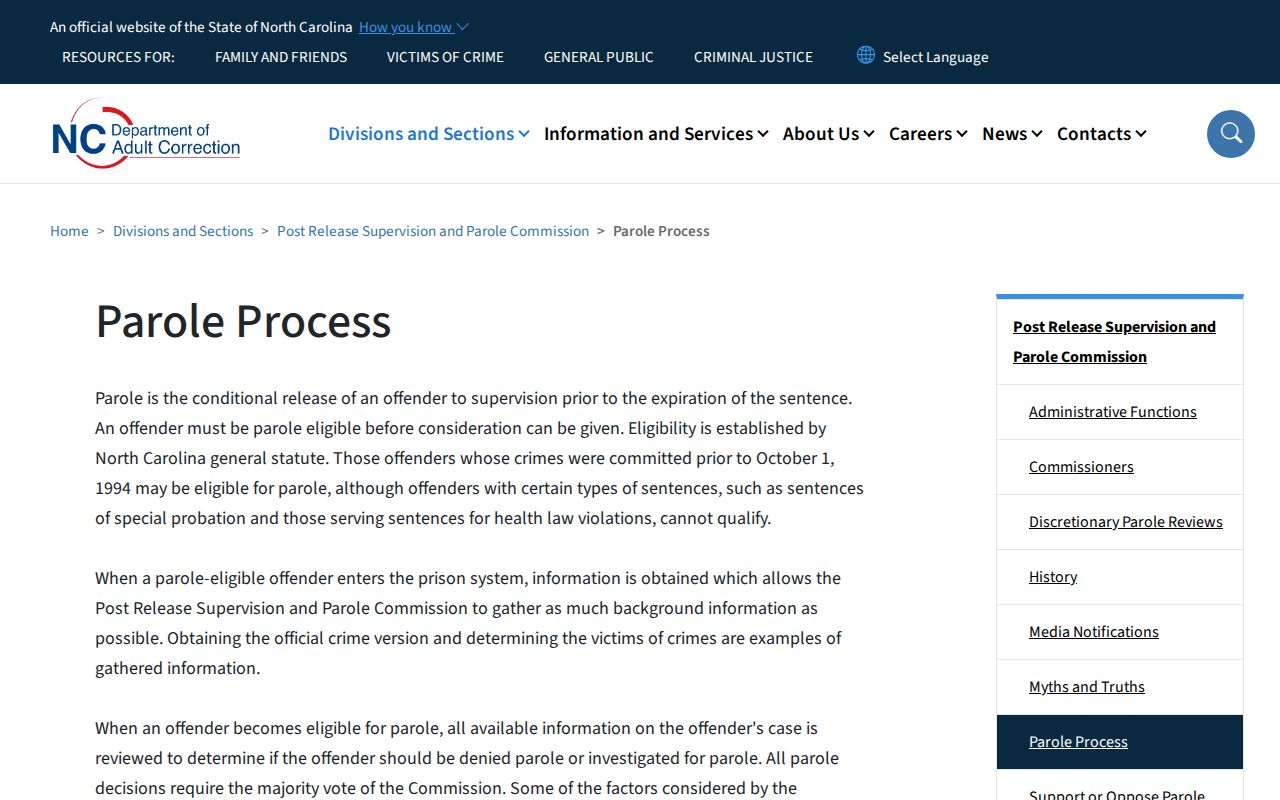
This source helps separate a true parole decision from ordinary modern post-release supervision.
Brunswick Supervision Record Status
The state detail can contain the person’s photo, offender number, incarceration status, supervision status, office, admission and release dates, sentence history, and actual release date. Read those entries as a timeline. A prison release date marks the end of that incarceration event. The active supervision entry shows state authority continuing in the community. A later termination or discharge entry is the proof that supervision ended.
Names can match more than one person. Separate custody episodes can also appear under one person. Compare the sentence number, offense date, docket, conviction county, admission, actual release date, parole start, and parole end. A custody review date is not automatically a parole hearing. NCDAC specifically warns about that distinction. When a field conflicts with a court order, ask the agency that created the field to clarify it rather than guessing which date controls.
Brunswick Parole Review Results
North Carolina does not publish a conventional person-by-person forward hearing calendar for ordinary discretionary parole. Commissioners generally review and vote on cases individually instead of meeting as a group for a face-to-face hearing. The useful public substitute is the monthly Discretionary Parole Reviews archive. Its reports are results by month, not a personalized lookup and not a promise of a future release date.
Published categories include Incomplete Decision, Suspend Decision, Regular Parole, Community Service Parole, Early Medical Release, and 90-day Mandatory Parole. An incomplete result means more information or investigation is needed. A suspended decision stops consideration for the time stated. Neither term should be converted into “released.” Likewise, continued review is not permanent denial. Confirm the person’s exact NCDAC record after reading a monthly result.
The Commission’s myths and truths explanation documents why an ordinary review should not be described as a scheduled public hearing.
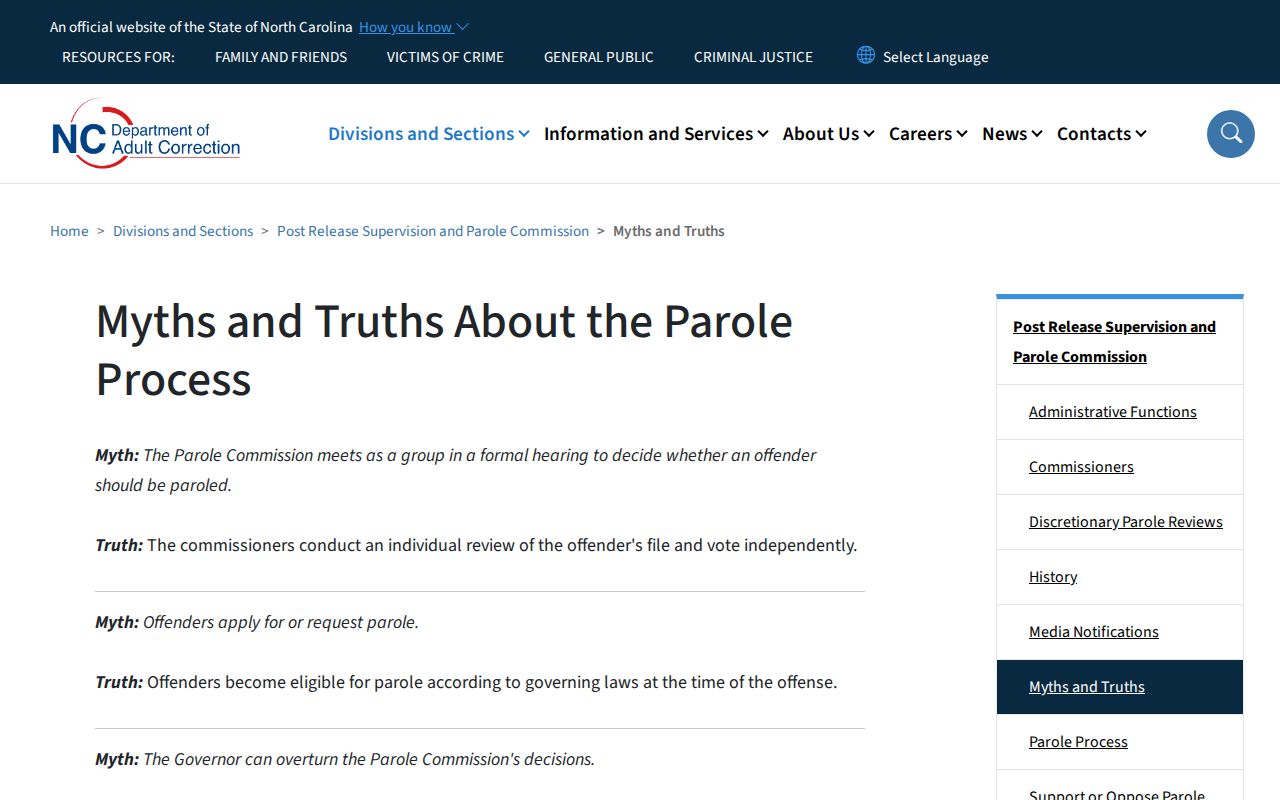
The distinction matters because a review date, result date, release date, and supervision start can all be different.
Brunswick Probation Office Contact
After the statewide record points to Brunswick County supervision, the local office can confirm a public reporting route or office location. Staff may not disclose protected case details. The public directory provides a general probation and Community Supervision line rather than an individual officer’s private contact information. This is the proper limit for a public status inquiry.
NCDAC Community Supervision, Brunswick
Phone: 910-253-7803
Fax: 910-253-7813
Use: Confirm the local office or public reporting route after matching the NCDAC record.
The Brunswick public directory entry is the source for those numbers.
The listing supports office routing, but it does not make confidential supervision notes public.
Brunswick Supervision Violations
Conditions are the rules attached to probation, parole, or post-release supervision. A violation is an alleged breach of those rules. An absconder is a person placed in an official supervision status after evading supervision, not merely someone who missed a casual meeting. Public Offender Search and official warrant channels are the appropriate public checks. Research found no separate Brunswick Sheriff absconder list, so no local list should be assumed.
North Carolina law provides revocation procedures. The Commission may respond to post-release or parole violations within its statutory role, and a court handles probation matters within its authority. Reconfinement means being placed back in secure custody. It is not the same as a final revocation decision. Under Article 84A, a final post-release revocation hearing generally must occur within 45 days of reconfinement unless waived or another statutory rule applies.
G.S. 15A-837 also requires specified victim notifications for supervision events such as absconding, capture, termination, and discharge. NC SAVAN may deliver a status notice, but the originating agency record remains the source for the event.
A warrant and a supervision status are related but distinct records. Public Offender Search may show the supervision condition, while a court or official warrant source documents the legal process. Do not infer a warrant from a stale address, a missed report, or a missing public result. If SAVAN reports reconfinement, compare that event with NCDAC and the court file. The reconfinement date marks a return to custody. A later order or Commission action determines whether supervision was revoked, continued, or changed.
Brunswick Reentry Council Navigation
NCDAC lists a Duplin/Pender/Brunswick Reentry Council operated with LINC. It offers a local route for orientation, resource navigation, and case management after return to the community. The council is not the source for an official parole, probation, or release status. Verify state supervision first, then use the council for its stated support role.
The NCDAC Local Reentry Councils page identifies the program. The council contact is 910-332-1138, and the current Brunswick council flyer gives a county case-manager line at 910-380-9291. Those numbers serve different roles, so keep the label with the number when calling.
Note: Reentry help does not prove release, discharge, or supervision status; those facts come from NCDAC, the court, or the releasing agency.
Ending Brunswick Post-Release Supervision
Supervision ends through an official termination or discharge, not merely through the passage of a projected date. For a state prisoner, first identify the incarceration release. Then read the probation, parole, or post-release history for an end date and status. If the public display is unclear, request the supervision history or termination record from NCDAC. The Brunswick office may route a public inquiry, but only the responsible agency record can settle the status.
A court order may end or change probation. The Brunswick Clerk’s file can contain the original probation judgment and later revocation or termination entries. The state record and court file serve related but distinct purposes. Label each event by agency and date. That practice prevents a prison-release date from being mistaken for the end of all state authority.
For a complete check, keep three dates separate: release from incarceration, the start of community supervision, and termination or discharge. A person may have more than one sentence or supervision episode, so match the sentence number and docket as well as the name. When the NCDAC detail remains active after the expected end date, request the current supervision history rather than calculating discharge from a term shown elsewhere. Credits, violations, and later orders can affect the official end point.